Voltage Spikes: How Latency Compensation Algorithms Dictate Hit Registration in Fast-Paced Online Shooters
Kai Peters · Aug 3, 2026
Voltage Spikes: How Latency Compensation Algorithms Dictate Hit Registration in Fast-Paced Online Shooters
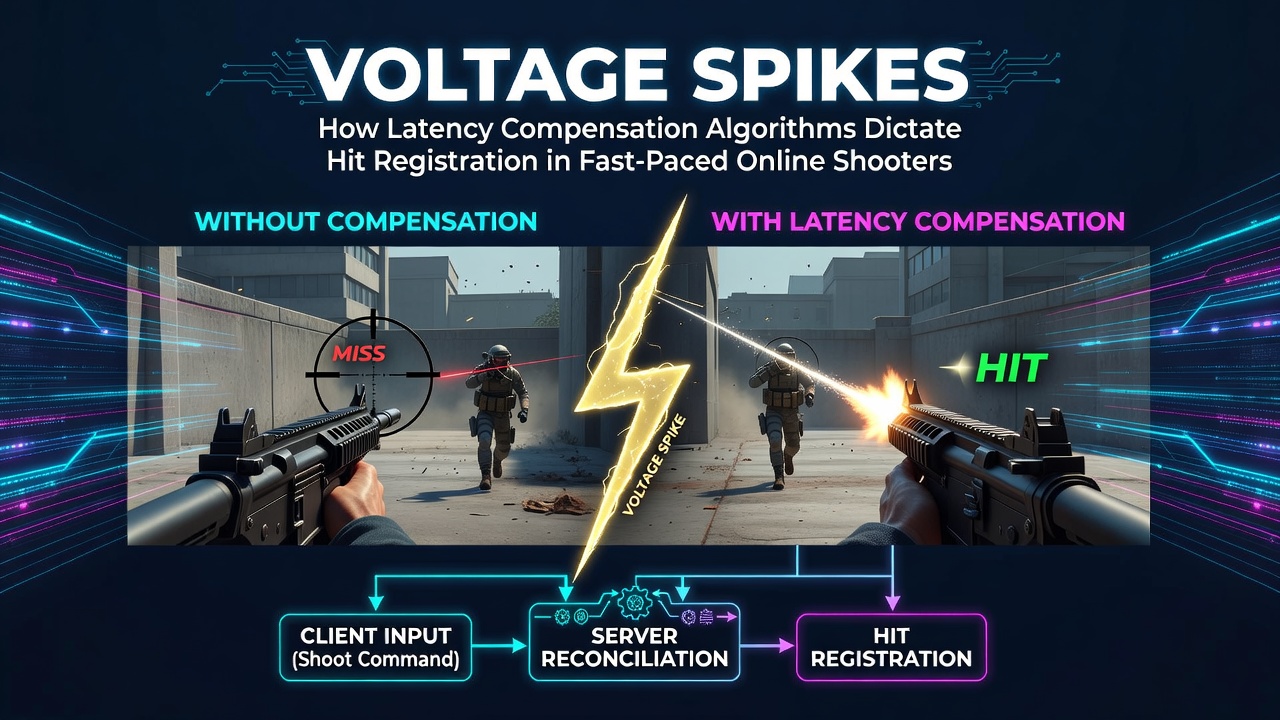
Fast-paced online shooters rely on intricate latency compensation algorithms that manage data transmission between clients and servers, and these systems directly shape how hits register during intense matches. Voltage spikes, defined as abrupt surges in network latency or packet jitter, often disrupt the timing of player actions and server validations. Research from networking studies shows that such spikes occur when connection stability fluctuates due to routing changes or bandwidth contention, and developers counter them through techniques like client-side prediction combined with server reconciliation.
Core Mechanisms Behind Latency Compensation
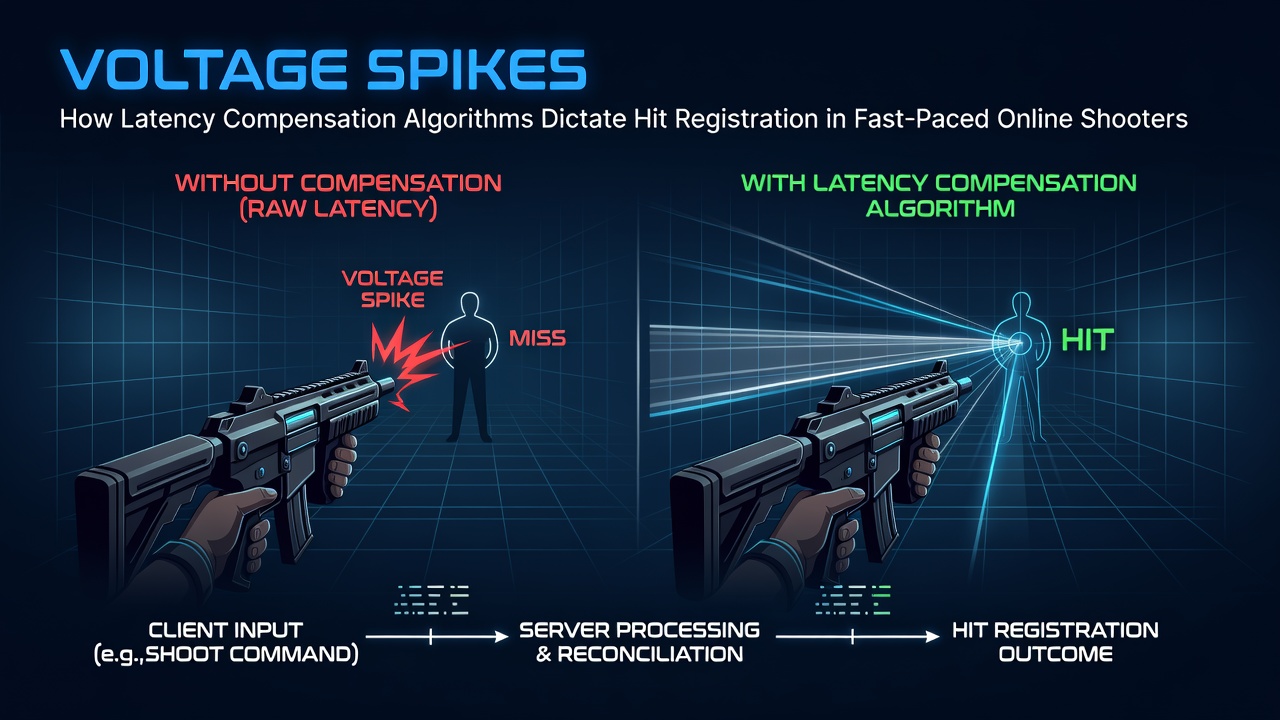
Latency compensation begins with client-side prediction, where the game client simulates player movement and shooting immediately upon input while awaiting server confirmation. This approach reduces perceived delay, yet it creates temporary discrepancies that the server must resolve later through reconciliation processes. Data indicates that reconciliation compares client-reported actions against authoritative server states, and mismatches lead to corrections that can alter hit outcomes. Observers note that interpolation smooths incoming entity positions from other players by blending past snapshots, which helps maintain visual consistency even when packets arrive out of order.
Extrapolation extends this further by projecting future positions based on velocity data, and this method proves useful during brief connection hiccups. Studies reveal that games adjust extrapolation windows dynamically to avoid over-prediction that might produce false positives in hit detection. Those who analyze netcode implementations find that tick rates, typically set between 64 and 128 per second in major titles, determine how frequently the server processes inputs and validates collisions.
How Voltage Spikes Disrupt Hit Registration
Voltage spikes manifest as sudden increases in round-trip time, often exceeding 100 milliseconds for short durations, and these events force algorithms to rely more heavily on prediction buffers. Hit registration suffers when a spike coincides with a shot, because the server may receive the input after the target has already moved according to its own simulation. Figures from industry reports demonstrate that compensation windows expand during detected spikes to accommodate delayed packets, but this expansion can introduce artifacts like delayed kill confirmations or apparent misses on the client's screen.
Algorithms incorporate rollback techniques in some modern implementations, where the server temporarily rewinds simulation state to the moment the input was generated. This rewind allows accurate collision checks against historical positions, and it reduces the impact of spikes on fairness. Researchers discovered that rollback requires careful bandwidth management, since transmitting additional state history increases data overhead during already unstable periods. People who examine match replays observe that spikes often cluster around high-action moments, such as when multiple players converge on objectives, because those periods generate denser packet flows.
Algorithm Variations Across Major Titles
Different engines apply compensation with distinct priorities, and one example appears in titles using Source-derived netcode that emphasize reconciliation after every client update. Another approach surfaces in engines designed around deterministic simulation, where inputs undergo strict sequencing to prevent desyncs even amid voltage spikes. Data shows that hybrid systems combine prediction with selective rollback, limiting rewinds to combat-related events rather than all movement. This selective method conserves processing resources while still addressing the most critical registration issues.
Regional infrastructure influences spike frequency, and studies conducted in North America highlight how peering agreements between providers affect routing stability compared to denser European networks. Industry analyses from organizations such as the Entertainment Software Association track how these variations influence player retention across different markets. Observers note that developers release periodic netcode patches to refine spike-handling logic, and updates scheduled around periods like August 2026 often target improved jitter buffers based on aggregated telemetry from live servers.
Measurement and Optimization Practices
Developers monitor spike patterns through server-side logging of latency histograms, and these logs reveal correlations between time of day and connection quality in populated regions. Optimization involves tuning compensation thresholds so that minor fluctuations do not trigger unnecessary rollbacks that could feel unresponsive. Evidence suggests that machine learning models now assist in predicting spike onset by analyzing traffic trends, allowing preemptive buffer adjustments before registration errors accumulate.
Academic papers from institutions in Australia have examined the relationship between tick rate scaling and hit accuracy under simulated spike conditions, and their findings guide parameter choices in competitive playlists. Those who review public technical documentation learn that many studios publish netcode overviews to explain how their algorithms balance responsiveness against authoritative accuracy. Such transparency helps communities understand why certain hits register differently during unstable sessions.
Conclusion
Latency compensation algorithms form the backbone of reliable hit registration in fast-paced online shooters, and voltage spikes represent one of the persistent challenges these systems must accommodate. Through layered techniques including prediction, reconciliation, interpolation, and selective rollback, developers maintain playable experiences despite network variability. Continued refinement of these methods, supported by telemetry and cross-regional infrastructure improvements, shapes the ongoing evolution of competitive multiplayer integrity.