Charting the Felt: Decision Trees for Video Poker Variants and Payout Structures
Morgan Simon · May 27, 2026

Charting the Felt: Decision Trees for Video Poker Variants and Payout Structures
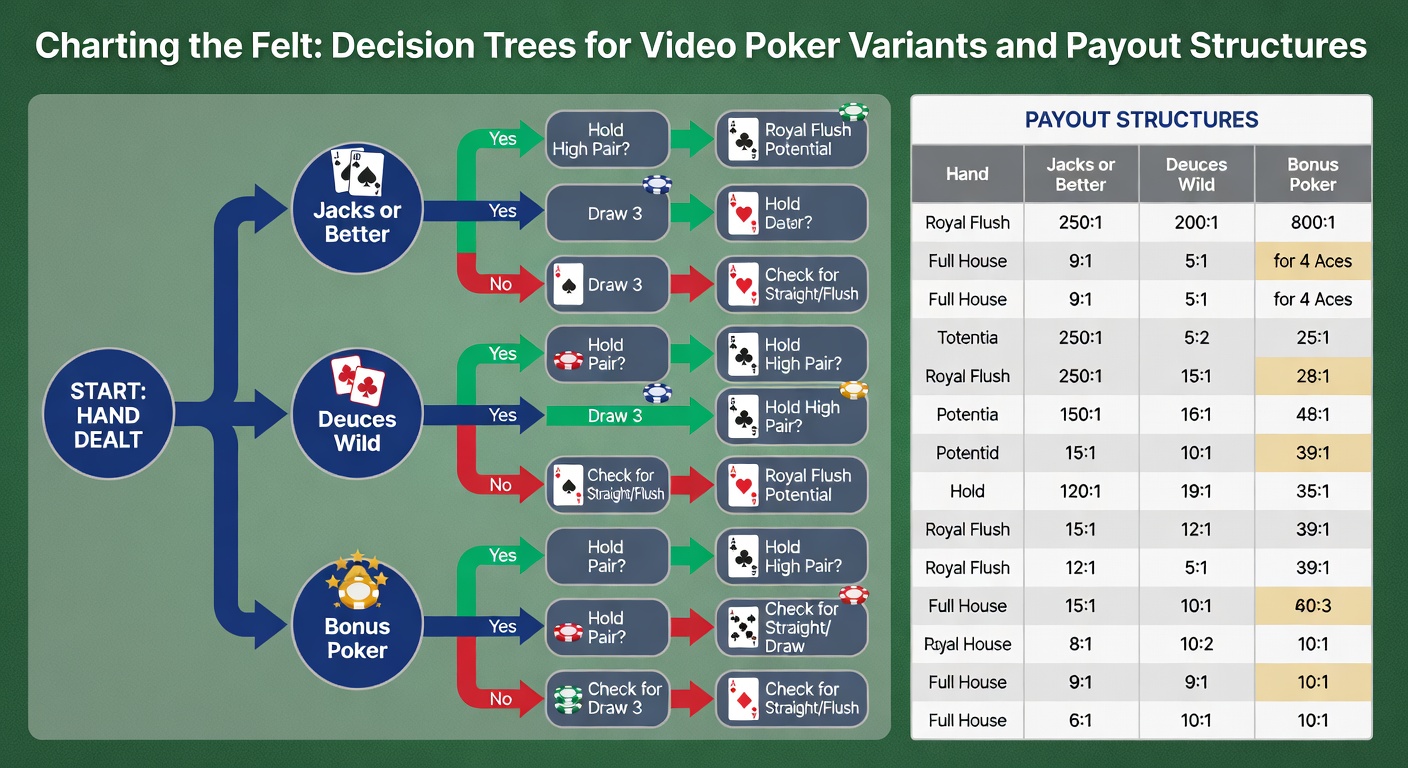
Video poker combines elements of slot machines and traditional poker through electronic terminals that deal five-card hands from randomized decks, and players decide which cards to hold or discard before a second draw determines the final outcome. Decision trees map these choices by evaluating every possible combination against specific paytables, where each branch calculates expected value based on remaining cards and payout multipliers for hands like royal flushes, straight flushes, four of a kinds, full houses, flushes, straights, three of a kinds, two pairs, and high pairs.
Researchers at institutions such as the University of Nevada, Las Vegas Center for Gaming Research have documented how these trees shift dramatically between variants because paytable structures alter the relative value of certain holdings. In Jacks or Better, for instance, a pair of jacks or better returns even money while lower pairs return nothing, which forces trees to prioritize high pairs over potential draws that might appear attractive in other formats.
Core Variants and Their Structural Differences
Jacks or Better serves as the baseline format with standard five-card draws, whereas Deuces Wild treats all twos as wild cards that substitute for any rank or suit to complete winning combinations. This wild element expands the decision tree branches because players must account for multiple ways a single deuce can upgrade a hand, such as turning three of a kind into a full house or four of a kind into five of a kind. Joker Poker introduces a single joker as a wild card alongside a 52-card deck, creating hybrid trees that weigh the joker's flexibility against the reduced natural card pool.
Bonus Poker variants add extra payouts for specific four-of-a-kind combinations like aces or twos through fours, which lengthens the tree at the four-of-a-kind node and requires players to recalculate hold decisions when those bonus cards appear. Double Bonus Poker and Double Double Bonus Poker further layer multipliers onto certain full houses and flushes, pushing trees to favor suited connectors or specific kickers that standard formats might discard.
How Payout Structures Shape Optimal Branches
Paytable configurations determine the break-even points within each decision tree, and data from regulatory filings with the Nevada Gaming Control Board shows that machines offering 9/6 Jacks or Better return 99.54 percent under perfect play while 8/5 versions drop to 97.30 percent. These percentage differences arise because lower flush and full house payouts reduce the expected value of drawing to those hands, causing the tree to recommend holding pairs or three-card straights more conservatively.
In Deuces Wild, a 25/15/9/5/3/2/1 paytable for five of a kind through three of a kind produces different holding priorities than a 20/12/8/4/3/2/1 structure, since the reduced five-of-a-kind multiplier lowers the value of keeping multiple deuces in certain marginal situations. Observers note that players who apply the same tree across mismatched paytables often encounter negative expected value on draws that previously carried positive returns.
Constructing Decision Trees for Specific Scenarios
A basic tree for Jacks or Better begins by checking for pat hands that already pay, such as straights or better, then descends into draw categories ordered by expected value: four to a royal flush, three to a royal flush, four to a straight flush, and so on down through high pairs, low pairs, three-card straights, and suited connectors. Each node factors in the number of outs remaining in the deck after accounting for known discards, which produces precise percentages that guide the final hold choice.
Deuces Wild trees insert additional layers that evaluate wild-card combinations first, then compare natural hands against wild-assisted upgrades; for example, four deuces always hold because the payout exceeds any redraw potential, yet three deuces paired with an ace may split depending on whether the paytable rewards five of a kind or four of a kind more heavily. Australian gambling research published through the South Australian Centre for Economic Studies has tracked how these layered calculations affect session-level returns when players face multi-hand machines that apply the same tree across simultaneous deals.
Advanced software packages simulate millions of hands to refine tree accuracy, revealing edge cases such as holding a single ace in Deuces Wild when the paytable pays 800 credits for a royal flush versus discarding it to chase a deuce-assisted straight flush. These simulations also flag situations where two-card royal draws outperform three-card straight flushes under specific multiplier conditions.
Regional Regulatory Context and Data Tracking
Regulatory bodies across jurisdictions require video poker terminals to post theoretical return percentages calculated from optimal decision trees, and the New Jersey Division of Gaming Enforcement maintains public databases listing approved paytables for each licensed machine. Similar transparency measures appear in reports from the Malta Gaming Authority, which oversees international online video poker platforms and mandates disclosure of variant-specific return-to-player figures derived from exhaustive tree analysis.
Industry associations such as the American Gaming Association compile aggregate data showing that video poker accounts for roughly 8 percent of slot floor revenue in many U.S. markets, with decision-tree software updates frequently deployed when operators adjust paytables to meet new regulatory thresholds. These updates ensure that displayed strategy cards remain synchronized with current machine configurations, preventing mismatches that could alter expected values by several percentage points.
Conclusion
Decision trees provide the analytical framework that converts video poker from a game of intuition into one governed by precise expected-value calculations tailored to each variant and paytable. As operators continue introducing new bonus structures and multi-hand formats, the underlying trees expand in complexity yet remain anchored to the same foundational principles of outs counting and payout comparison. Players who master these mappings across Jacks or Better, Deuces Wild, and bonus variants gain access to the highest theoretical returns available on the felt, provided they apply the correct branch for every hand configuration encountered.